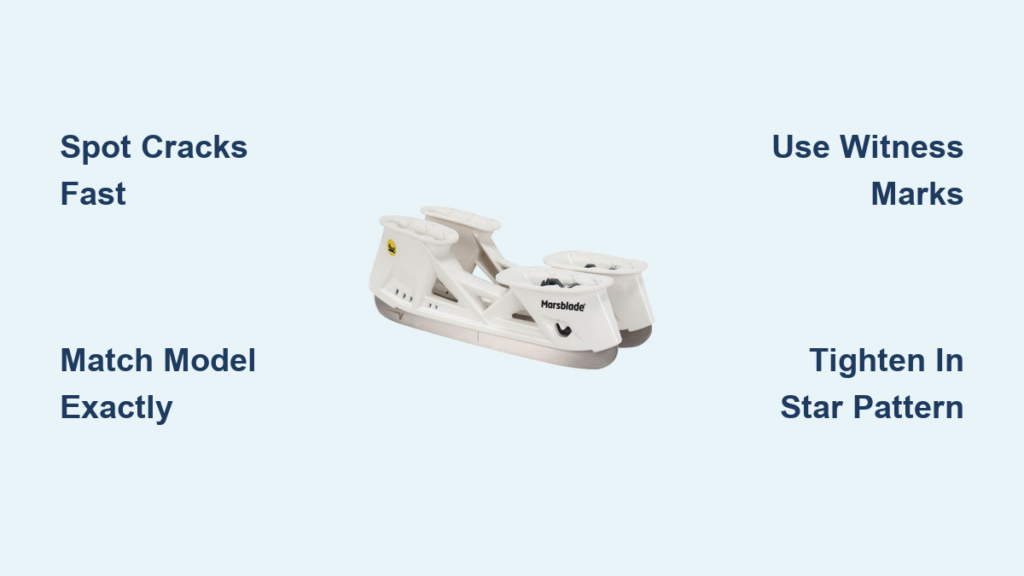
Your blade holder just cracked mid-game. The steel runner wobbles with every stride, and you can actually see daylight through a split near the toe. Before you panic-buy new skates, know this: how to replace skate blade holder is a straightforward 30-minute fix that costs under $70—far less than replacing perfectly good boots. When plastic fatigue or impact damage compromises your holder, this repair restores structural integrity and blade security without sacrificing your boot’s performance.
In this guide, you’ll learn exactly how to diagnose when replacement beats buying new skates, which holder to order without guessing, and the step-by-step process that keeps your steel locked solid for hundreds of games. Whether you’re dealing with stripped T-nuts or visible cracks, mastering how to replace skate blade holder saves money and gets you back on ice faster than waiting for shop service.
Spot Critical Holder Damage Before It Fails Completely

Hold the skate sole-up under bright light. Hairline cracks around any bolt hole mean immediate replacement—stress concentrates here and spreads fast during hard stops. Press the holder mounting points with your thumb; if the plastic feels “mushy” and screws spin freely, the internal T-nuts have stripped their molded seats. This fatigue happens gradually as plastic compresses from repeated tightening cycles, especially in Bauer Tuuk Lightspeed or CCM Prolite models.
Why Ignoring Cracks Risks Catastrophic Failure
A hairline fracture near the toe bolt will rapidly propagate under skating forces. During a hard cut, the holder can snap completely, sending your blade flying mid-stride. Never skate with visible cracks—the sudden loss of edge control often causes falls or collisions. If you see daylight through the plastic or feel blade movement when twisting the steel sideways, stop using the skate immediately. Continuing to skate risks damaging the boot sole or causing injury.
Quick Decision Table: Holder Repair vs. New Skates
| Symptom | Action |
|---|---|
| Visible crack through bolt hole | Replace holder now |
| Blade spins inside holder even with new hardware | Holder plastic fatigued |
| Holder screw holes wallowed out | Replace (T-nuts are molded in) |
| Boot sidewalls soft; eyelets deflect >¾” | New skates wiser |
| Holder discontinued & unavailable | Consider aftermarket retrofit |
Match Your Exact Holder Model to Avoid Costly Mistakes

Bauer, CCM, True, Graf, and Warrior all use proprietary hole patterns. A single-letter mismatch (LS2 vs LS Edge) can leave you drilling new holes in a $400 boot. Order the exact model stamped on your current holder—Bauer Tuuk Lightspeed 2, CCM SpeedBlade XS, True Shift, etc. Check manufacturer websites for compatibility charts if your holder is worn clean of markings.
Left vs. Right Holder Confusion
Holders are side-specific—order one “L” and one “R.” Installing a left holder on the right foot misaligns the blade angle, causing poor edge control. Confirm by comparing the new holder to your old one: the blade channel will angle differently for each foot. Cross-check the skate size printed on the boot tongue against the manufacturer chart; the runner size stamped on your existing steel (e.g., “11” for 11-inch radius) is a quick double-check.
Aftermarket Solutions for Discontinued Holders
CCM Prolite and E-Blade series are discontinued, but newer CCM XS or Bauer Edge holders often bolt straight onto older boots. Critical step: Lay the new holder against the sole before removing the old one. Verify all mounting holes align perfectly—don’t rely solely on model year charts. Entry-level Bauer ONE20 skates make excellent donor chassis for cracked high-end boots since they accept standard Lightspeed Edge holders.
Gather These 5 Essential Tools Before Starting
- Replacement holder(s) with correct screws/bolts (holder + steel combo sets save $10)
- Phillips screwdriver or Allen key matching your hardware (CCM triggers often need 3mm hex)
- Marker for witness marks (prevents misalignment during reassembly)
- Soft cloth to protect boot finish from scratches
- Optional thread-locker (medium-strength Loctite for recurring screw loosening)
Skip rivet tools unless you own a press—copper rivet jobs require professional equipment. Most modern skates use screws, but Graf 700-series and older models need rivets.
Remove Damaged Holder Without Damaging Your Boot
Uncover Hidden Fasteners in Quick-Release Systems
Traditional models expose 4–6 screws along the outsole. Newer quick-release systems (CCM XS, Bauer Edge) hide screws under a trigger plate—pop it out first using a small flathead screwdriver. Back each fastener evenly; if a screw spins, press outward on the holder to add tension while turning. This prevents T-nut stripping in soft plastic holders.
Break the Adhesive Bond Safely
Gently pry the holder straight down. Factory adhesive may resist; slide a thin plastic wedge (like a guitar pick) between holder and sole to break the bond without gouging. Never use metal tools—they scratch carbon soles and compromise structural integrity. For riveted holders, drill or punch out old copper rivets; this is best left to pro shops unless you own a rivet press.
Align New Holder Perfectly Using Witness Marks
Brush away debris and dried adhesive from the mounting surface. Lay the new holder in place and mark through each mounting hole onto the boot with a pencil. These witness marks prevent misalignment when you start driving screws. Critical check: ensure the blade channel runs parallel to the boot centerline. A 1mm offset here causes inconsistent edge performance.
Install Holder with Zero Play in 4 Critical Steps

Finger-Tighten All Screws First
Seat the new holder so the blade channel runs parallel to the boot centerline. Insert all screws finger-tight first; every hole must line up before tightening. A single offset screw can crack the holder or strip the T-nut. If holes don’t align, stop immediately—you likely have the wrong holder model.
Tighten in Star Pattern to Prevent Warping
Snug screws in opposite corners first, then the remaining pairs (like tightening a car wheel). Tighten firmly—screw heads flush—but stop before the driver cams out. Overtightening cracks plastic or spins T-nuts permanently. Pro tip: For CCM triggers, leave the front screw slightly loose to allow blade movement during installation.
Rivet Installation for Older Models
If your boot uses rivets, compress each copper rivet until the flare seats flush against the holder. No visible gap should exist between holder and outsole. This requires 8-10 tons of pressure—impossible with hand tools. Budget $15 for shop riveting if you lack a press.
Test Blade Security Before Hitting the Ice
Slide the runner into the new holder and engage the locking mechanism. Wiggle the blade—zero lateral play should be felt. Lace the skate, stand on carpet, and rock fore-aft; any clicking means re-check tightness. Critical field test: Perform hard stops on concrete—loose holders often feel fine standing but fail under skating force. Final on-ice test: execute tight turns at speed. Any vibration means disassemble and recheck alignment.
Pro Shop vs DIY Cost Breakdown (2024 Pricing)
| Service | DIY Cost | Pro Shop Cost |
|---|---|---|
| Holder only | $25–32 | $25–32 |
| Holder + steel combo | $55–65 | $55–65 |
| Labor | $0 | $15–25 |
| Rush fee | $0 | $10–15 |
If you value your Saturday morning ice time, letting a shop swap both holders in 20 minutes can be worth the extra $30. But for routine replacements, how to replace skate blade holder yourself saves $50+ per skate annually if you maintain multiple pairs.
Extend Holder Life With 3 Simple Maintenance Habits
- Dry holders after sharpening: Trapped water corrodes screws—wipe with microfiber cloth
- Check blade screws every 3–4 sessions: Especially CCM trigger models prone to loosening
- Apply thread-locker sparingly: Medium-strength compound on screw threads prevents vibration-induced loosening
Rotate spare steel runners to distribute sharpening wear and delay runner replacement. Graf 700-series holders often outlast boots with this practice.
When New Skates Beat Holder Replacement
Replace the holder only when the boot remains stiff and the combined cost stays below ~40% of new skates. Replace skates instead if:
– Boot sidewalls compress easily under hand pressure
– Top eyelets deflect more than ¾ inch when pulled
– Holder is obsolete (e.g., CCM E-Blade) with no retrofit options
– Combined repair cost exceeds $120 for clearance-level new skates ($150–200)
Clearance skates often include modern holders—making them smarter than hunting rare parts.
With fresh holders bolted on and blades locked tight, you’re back on the ice without the sticker shock of new skates. How to replace skate blade holder yourself transforms a season-ending disaster into a 30-minute pit stop. Mark your calendar for a screw check next month, and these holders will carry you through seasons of hard stops and sharp cuts. Remember: when cracks appear, immediate action prevents costly boot damage—so keep spare holders matching your model in your hockey bag. You’ll never sit out another game waiting for shop service.