
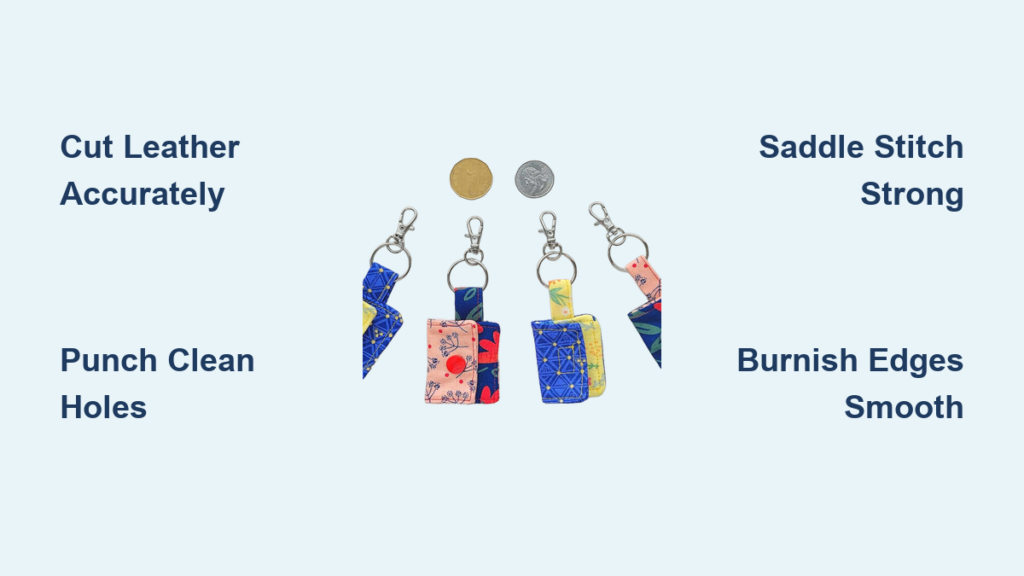
You’re juggling groceries, your phone rings, and the parking meter’s blinking red. Frantically digging through pockets for a quarter, you drop your keys and spill change everywhere. This daily frustration ends the moment you learn how to make a quarter holder keychain – that tiny leather sleeve clipped to your keys that always delivers when you need it most. Forget rattling coins or empty pockets; this handmade essential ensures a quarter’s never far when vending machines, laundry days, or parking meters demand payment.
Creating your own leather quarter holder takes less time than your morning coffee run and costs under $3. In this guide, you’ll discover foolproof techniques to craft a professional-looking keychain that withstands daily abuse while developing a rich patina. Whether you’re a leatherworking novice or seeking a meaningful handmade gift, we’ll transform raw materials into a functional heirloom you’ll use for decades. By the end, you’ll know exactly how to make a quarter holder keychain that fits seamlessly into your life.
Gather These 7 Must-Have Supplies for a Durable Quarter Holder
Skip the guesswork with this curated toolkit – every item serves a critical purpose in your quarter holder build. Start with a 2″ x 4″ vegetable-tanned leather scrap at 2-3mm thickness; this Goldilocks zone holds structure without resisting folds. Thin leather cracks, while thick pieces won’t hug your quarter snugly. Pair it with a standard 1″ split key ring (tested to hold 15+ pounds) and waxed linen thread in contrasting colors for visibility during stitching.
Critical additions you can’t skip:
– 1mm leather punch for precise stitch holes
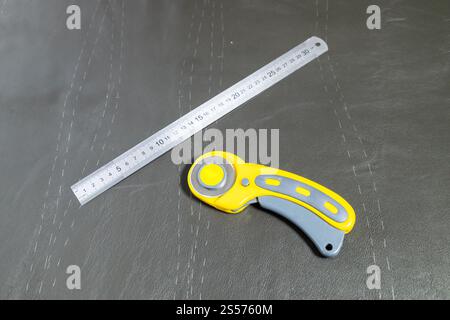
– Sharp rotary cutter (not scissors – they crush leather edges)
– Metal ruler to prevent blade slippage
– Self-healing cutting mat protecting your work surface
– Quarter coin (for real-time fit checks during construction)
Vegan crafters: substitute with 2mm faux leather or canvas reinforced with iron-on interfacing. Paracord weavers can skip leather entirely for a braided alternative, while brass tubing creates an industrial look – but stick to leather for your first build. Measure twice, cut once: the quarter’s 0.955″ diameter demands exact 1.25″ pocket width.
Cut Perfect Leather Pieces Using the 3-Pass Rule
Create Your Quarter-Specific Template First
Draw a 3″ x 1.5″ rectangle on paper – this isn’t arbitrary. The 1.5″ height accommodates the quarter’s 0.069″ thickness plus 0.75″ pocket depth. Mark your fold line exactly 1.25″ from the bottom; any deviation causes fit issues. Add 0.25″ seam allowance on both sides and punch your key ring hole 0.25″ from the top center – too low and it blocks the pocket, too high and stress cracks develop.
Transfer Patterns Without Distortion
Secure your paper template to leather with binder clips – never tape, which leaves residue. Trace with an awl (not a pen; ink bleeds through leather). Now mark stitch holes 1/8″ apart along the sides using a specialized pricking iron. This spacing prevents gapping while avoiding bulk. Misaligned holes? Repunch using your first hole as a guide – precision here avoids crooked stitching later.
Execute Flawless Cuts Every Time
Place your metal ruler firmly against the traced line. Make three light passes with your rotary cutter instead of one heavy cut. This technique prevents “wandering” edges and keeps cuts razor-straight. Always cut away from your body with the blade fully extended – a single slip ruins your piece. Test-fit your quarter immediately after cutting; it should slide in with slight resistance but stay put when inverted.
Punch Clean Stitch Holes and Finish Edges Like a Pro
Avoid Ragged Hole Disasters
Punch from the smooth side toward the rough side – this prevents fraying on your visible surface. Use a 1mm punch for thread (thicker thread = 1.5mm holes). For the key ring, 4mm is the sweet spot; 5mm risks leather tearing, while 3mm won’t accept the ring. Place your leather on a scrap wood block – punching on a hard surface cracks the tool. Test the ring insertion now; if it binds, gently rotate the punch to widen the hole.
Burnish Edges to Professional Perfection
Bevel sharp edges with an edge beveler – this removes 0.5mm from corners so they don’t catch on fabric. Now burnish aggressively with a bone folder: rub edges with soapy water until they shine like glass. This seals fibers against moisture damage. Skip edge paint for your first build; it’s easy to overapply and creates sticky seams. Check edges with your fingernail – if it snags, you’ve missed a spot.
Pre-Stitch Validation Test
Fold your piece and insert the quarter 20 times before stitching. It should release smoothly but not fall out when shaken. Too tight? Lightly sand the pocket interior with 220-grit paper. Too loose? Add a 0.5mm leather shim along the fold line. This step prevents irreversible mistakes – never skip the fit check.
Saddle Stitch Like a Leatherworking Pro (No Machines Needed)
Thread Setup for Maximum Strength
Cut thread 4x your seam length (e.g., 24″ for a 6″ seam). Thread both ends through the needle – this creates the legendary saddle stitch strength. Wax the thread by pulling it through beeswax 3x; unwaxed thread frays and weakens. Begin with a locking stitch: make 3 tiny stitches in the first hole before proceeding. This prevents unraveling if the knot fails.
Execute Flawless Stitches Under Tension
Keep consistent pull tension – too tight warps leather, too loose creates gaps. Anchor your piece with a stitching pony (or binder clips) to free both hands. Insert the needle perpendicular to the edge for even spacing. At corners, backstitch 4 stitches before turning to prevent splitting. End with another locking stitch: 3 passes through the final hole before knotting.
Choose Your Stitch Pattern Wisely
- Traditional saddle stitch: Best for beginners – simple in-and-out motion
- Box stitch: Decorative X pattern for showpieces (add 10 minutes)
- Whip stitch: Beginner alternative – loops around the edge (less durable)
Avoid cross stitch for coin holders; diagonal tension distorts the pocket shape. Pull each stitch snug but never taut – leather needs breathing room.
Assemble Your Holder and Secure the Key Ring Permanently

Fold and Stitch the Pocket Seam
Align edges perfectly before stitching – misalignment here ruins functionality. Insert the quarter during stitching to maintain pocket shape. Stop stitching 0.25″ from the fold to avoid bulky corners. After completing seams, test insertion 30 times; new leather tightens during use. If resistance increases, your fold line was misplaced – adjust before final conditioning.
Install the Key Ring Without Failures
Slide the split ring through the hole before final stitching. Use needle-nose pliers to fully close the ring – an open gap catches on clothing and damages phones. Test swing clearance: the ring must rotate freely without binding against leather. If it sticks, widen the hole by 0.5mm and re-burnish edges.
Condition for Immediate Usability
Apply leather conditioner with a microfiber cloth, focusing on stress points. Let it absorb 30 minutes before buffing – rushing causes sticky residue. Now test with 50+ insertions; properly conditioned leather breaks in within 24 hours. Never skip this step: unconditioned leather cracks within weeks of use.
Fix These 3 Fit Problems Before They Ruin Your Holder
Quarter Won’t Stay Put? Add Instant Friction
If your quarter falls out when inverted, sand the pocket interior with 400-grit paper for 10 seconds. Too aggressive? Stop immediately – you can always sand more. For instant fixes, glue a 1/8″ leather tab inside the pocket entrance. This creates a “lip” that grips the coin without affecting insertion.
Stitches Gapping? Tighten Your Technique
Gaps appear from inconsistent tension or misaligned holes. Fix by re-stitching with thicker thread (0.8mm instead of 0.6mm). For existing gaps, apply leather cement along the seam before conditioning – it swells fibers to close gaps. Prevent future issues by marking holes with a pricking iron instead of guessing spacing.
Key Ring Snagging Fabric? Smooth the Edges
Rough hole edges catch threads – re-burnish immediately with soapy water. If the ring binds, enlarge the hole by 0.3mm using a rotating punch motion. Always finish by rubbing the hole interior with a burnishing wheel; this creates a glass-smooth surface that won’t fray fabrics.
Maintain Your Holder for Decades of Reliable Service
Weekly Care Routine That Takes 60 Seconds
Wipe with a dry microfiber cloth after use – dirt acts like sandpaper on leather. Check stitches for looseness; a single dropped stitch can unravel the entire seam. Store in a cool, dry place away from car glove compartments (heat dries leather). Never leave quarters inside during storage – they leave permanent impressions.
Quarterly Deep Conditioning Protocol
Apply conditioner with circular motions, focusing on the pocket fold. Let it absorb 30 minutes, then buff with a clean cloth until no residue remains. For neglected leather, use a specialized leather cleaner before conditioning – never household soaps. Air-dry naturally away from direct sun; forced heat causes cracking.
Emergency Fixes for Field Failures
If a stitch breaks mid-use, temporarily secure with clear nail polish. For deep scratches, rub with a cotton swab dipped in leather dye matching your piece. If the pocket stretches permanently, add a leather shim inside – sand both surfaces, apply cement, and clamp for 1 hour.
Final Note: Your handmade quarter holder keychain solves real-world frustrations with elegant simplicity. By following these exact techniques, you’ve created a tool that pays for itself in saved time and reduced stress within weeks. Remember to condition after heavy rain exposure and avoid storing with metal coins for over a month – these small habits ensure your creation lasts decades. Now that you know how to make a quarter holder keychain, share the gift of preparedness: craft extras for family, or scale production to sell at craft fairs where these pocket heroes sell for $20+ apiece. Each time you effortlessly retrieve that quarter, you’ll appreciate the quiet pride of handmade reliability.


