
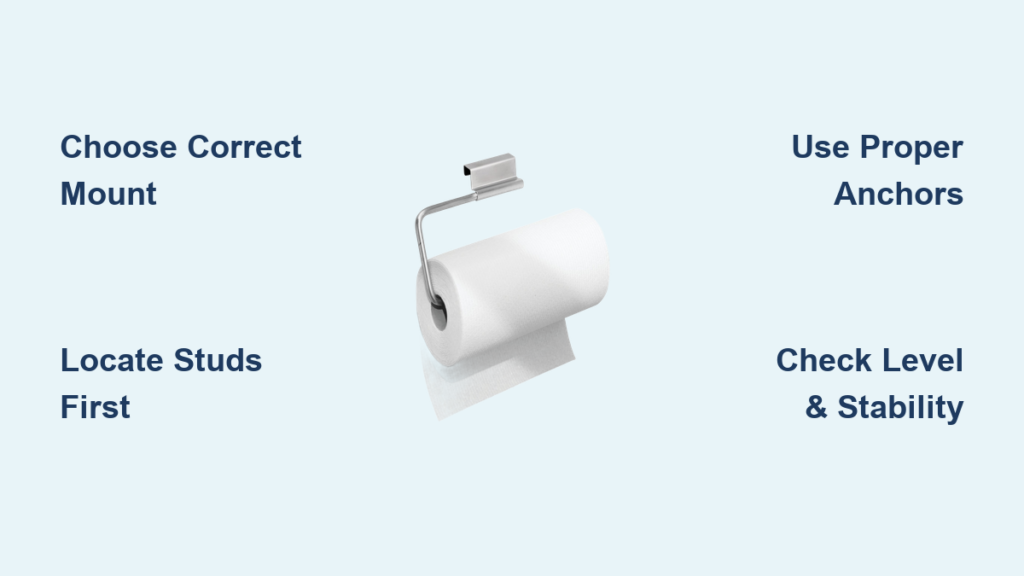
That moment when your paper towel holder comes crashing down mid-pull—wrenching the roll from your hands and scattering sheets across the kitchen floor—is every homeowner’s nightmare. Whether you’re staring at bare drywall, glossy tile, or a stainless steel fridge, how to install a paper towel holder correctly determines whether it becomes a daily convenience or a constant headache. Skip the guesswork: This guide delivers exact mounting techniques for wall, under-cabinet, countertop, and magnetic holders. You’ll learn precise heights, drill-free alternatives, and pro tricks to make any installation last years—no matter your surface type.
Pick the Right Holder for Your Surface Type
Your installation success hinges entirely on matching the holder to your wall or cabinet. Installing a heavy-duty wall mount on tile without proper anchors guarantees failure, while adhesive under-cabinet holders won’t survive daily use on particleboard. Choose wisely before grabbing tools.
Wall-Mounted Holders for Drywall or Tile
Requires drilling into studs or using heavy-duty anchors. Ideal for kitchens with open wall space near food prep zones. Critical detail: If studs don’t align with your ideal spot, skip the flimsy plastic anchors included in kits—use toggle bolts rated for 20+ pounds instead.
Under-Cabinet Holders for Space-Saving Mounting
Only viable if you have 12+ inches between cabinet bottom and countertop. Measures 1-2 inches from the cabinet’s front edge to avoid blocking drawers. Warning: Adhesive mounting tapes fail on laminated or painted cabinets—reserve this method for solid wood or MDF only.
Countertop Models for Zero-Drill Convenience
No installation needed, but stability is non-negotiable. Weighted bases must hit 2+ pounds (fill with sand or metal discs) to resist tipping when pulling sheets. Pro tip: Test stability by loading a full roll and nudging the base—if it slides, add rubber grip pads under the feet.
Magnetic Holders for Renters or Appliances
Works only on ferrous metal surfaces like refrigerators. Test grip strength first—true hold requires 50+ pounds of pull force. Avoid: Aluminum-framed appliances or double-walled fridges where magnets won’t adhere.
Wall-Mounted Holder Installation: Step-by-Step
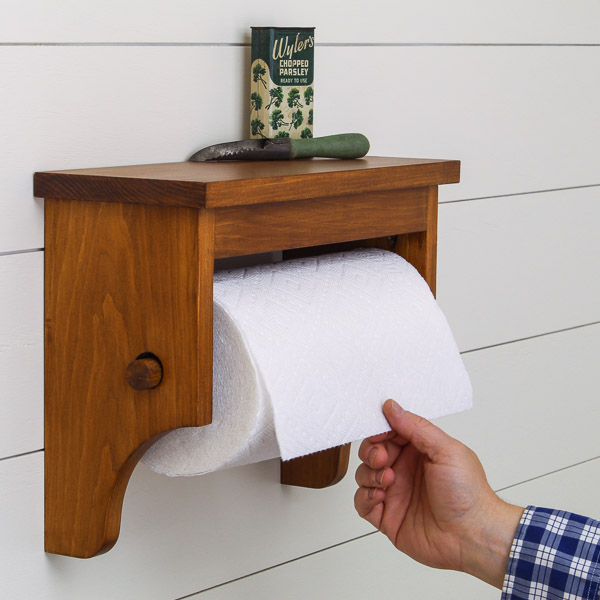
Position for Perfect Usability
Mark your spot 18-20 inches above the countertop—high enough to clear blenders but low enough for one-handed access. Stay 24 inches from the stove to prevent heat warping. Measure 6 inches left and right from the center mark to ensure roll clearance. Hold the holder against the wall, step back, and confirm it won’t hit your head when pulling sheets.
Locate Studs or Prepare for Anchors
Run your stud finder horizontally at your marked height. When it beeps, mark the stud’s center with an “X.” No stud at your spot? Drill a 3/16-inch pilot hole anyway—if the bit glides through drywall without resistance, you’re in hollow space. Switch to toggle bolts immediately; plastic anchors included in kits can’t handle repeated yanking force.
Drill and Mount to Prevent Wobble
Hold the bracket against the wall, check level, and mark screw holes with pencil. Drill pilot holes slightly smaller than your screws (e.g., 1/8-inch hole for #8 screws). For hollow walls, insert toggle bolts until wings snap open behind drywall. Drive screws slowly—stop when resistance increases sharply to avoid stripping anchors. Critical check: Yank the bracket sideways firmly before sliding on the holder. If it moves, remove and retry with larger anchors.
Under-Cabinet Mounting Without Damaging Wood
Verify Clearance Before Marking
Measure vertically from cabinet bottom to countertop—less than 12 inches means standard rolls won’t fit. Check for obstructions like cabinet hardware or drawer slides. Mark your position 1.5 inches from the front edge for easy access.
Choose Mounting Method by Cabinet Material
Solid wood/MDF cabinets: Drill 1/8-inch pilot holes first to prevent splitting. Drive screws slowly until snug—overtightening cracks particleboard.
Laminated or painted cabinets: Clean surface with rubbing alcohol, apply VHB tape strips, and press holder firmly for 60 seconds. Wait 24 hours before loading a roll—using it sooner risks adhesive failure.
Install Slide-Out Tracks Correctly
Mount tracks parallel to cabinet edges using the included screws. Test the slide action before tightening fully—if it binds, loosen screws slightly and adjust track alignment. For smooth operation, tighten tension screws until the holder glides with light resistance.
Tile Wall Installation Without Cracking

Drill Safely Through Ceramic or Stone
Cover your pencil mark with masking tape to prevent bit slipping. Use a carbide-tipped drill bit (not standard steel) at the lowest speed setting. Apply light pressure—let the bit do the work. Every 10 seconds, pause to drip water on the hole to cool the bit and reduce cracking risk. Never drill through grout lines: Target the tile’s center where structural integrity is strongest.
Anchor Selection for Tile Backer Boards
Plastic anchors included in kits often fail in tile installations. Use hollow-wall anchors specifically rated for tile (like SnapSkru anchors). Insert until flush, then drive screws slowly—stop when you feel slight resistance. Warning: If the anchor spins freely, the tile isn’t holding; fill the hole with epoxy and relocate 2 inches away.
Fix These Common Installation Mistakes Immediately

Stop Holder Wobble in Seconds
If the holder shifts when pulling paper towels, remove it and check screw depth. Stud-mounted screws should penetrate 1+ inch into wood. In hollow walls, replace plastic anchors with toggle bolts—they distribute weight across drywall backing. For severe wobble, add a third mounting point midway between existing screws.
Correct Misaligned Roll Rotation
Binding rolls usually mean the holder isn’t level. Remove it, fill old holes with spackle, and wait 24 hours for drying. Remount using a laser level for perfect alignment. Pro fix: Add rubber washers between the roll and holder ends to reduce friction if binding persists.
Prevent Paper Towel Slippage Forever
Loose rolls mean inadequate tension. Locate the tension adjustment screw (often hidden under a plastic cap) and turn clockwise in 1/4-turn increments. Test after each adjustment—ideal tension lets rolls spin freely but stops instantly when you release. For worn holders, slip rubber O-rings over the rod ends.
Monthly Maintenance That Doubles Holder Lifespan
Critical Safety Checks You’re Skipping
Test mounting security weekly: Grip the holder firmly and pull downward. Any movement means screws need tightening. In humid bathrooms, inspect monthly for rust on metal parts—replace with stainless steel models if corrosion appears. Child safety note: In homes with toddlers, mount wall holders at 48+ inches high and file down any sharp edges on the bracket.
Deep Cleaning for Sticky Residue
Grease buildup on under-cabinet holders causes adhesive failure. Remove the holder monthly, wipe the cabinet with degreaser, and clean the mounting surface with isopropyl alcohol before reattaching. For magnetic holders, demagnetize metal surfaces with a degreaser wipe to restore grip strength.
When to Hire a Pro (Before You Ruin Tile or Drywall)
Call a Handyman for These High-Risk Scenarios
- Installing near electrical outlets (within 12 inches) where drilling risks live wires
- Mounting on specialty tiles like glass mosaics or marble that crack easily
- Commercial kitchens requiring holders rated for 20+ pounds of constant use
- Walls with unknown materials (e.g., plaster over lath) where anchors fail
What Professional Installation Costs
Expect $75–$150 for standard drywall mounting, $100–$200 for tile work, and $50–$100 for under-cabinet jobs. Pros bring stud-scanning tools that detect pipes/wires and use industrial adhesives that outlast DIY tapes. Money-saving tip: Book multiple installations (e.g., kitchen + garage) for 15–20% discounts.
A rock-solid paper towel holder installation means pulling sheets with one hand while cooking, not scrambling to pick up scattered rolls. If your holder wobbles or the roll binds during testing, backtrack to alignment checks or anchor upgrades—never ignore early warning signs. Remember: The right method for your surface (stud-mounted for drywall, adhesive for solid cabinets, or magnetic for fridges) transforms a simple holder into a frustration-free kitchen essential. In just 20 minutes, you’ve eliminated one of the most common daily annoyances in home maintenance. Now load a roll, give it a firm tug, and enjoy the satisfying spin of a job done right.


